3 in 30 - 2001.11.18 Sunday
Recently I was asked to provide some of the “dirt” about Japan, the underside, the seamy side. In this series, constrained to the confines of our small, mostly residential neighborhood, that is a formidable task. Outside of high schoolers with dyed hair, some pachinko parlors, a downtown sauna, and a “Love” hotel with hourly rates catering to couples living with extended families crowded into small apartments, there isn't much scandal in our locale.
Certainly nothing on the scale of the loan company failures of the past eight years, or monumentally self aggrandizing as rejecting scientific reality, summarily discarding agreements that took decades to forge, or unilaterally ignoring world opinion just to suit one's own agenda.
On the other hand, it seems that much of the younger generation of Japanese are emulating westerners. There seem to be more and more large vehicles on the roads—roads that were designed for much more conservative, smaller vehicles. In the US, people scramble for larger, energy-gobbling machines, despite an energy crisis in the 1970s, government requirements for more energy efficient vehicles (albeit with loopholes), a second energy crisis in the 90s, even after the attacks of September 11.
The loophole exempted auto makers from producing “work” vehicles that met higher energy-efficient standards. When the loophole was created, only 15% of sales were in the so-called “light truck” category. “During the 90s,” says R. C. Longworth, a senior editor at the Chicago Tribune, “sales of these juggernauts—now valued more as status symbols than workhorses—soared to more than half of all new-car sales.” This year's October sales were higher than last year's. So much for decreasing our dependence on Mid-East oil and we can abandon lessening our likelihood of continued adventures in that part of the world.
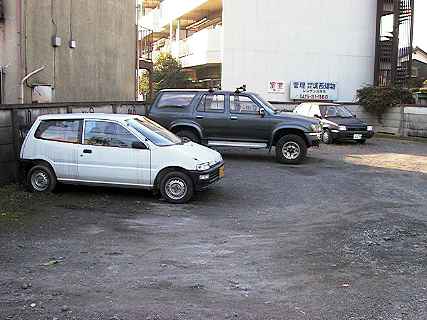
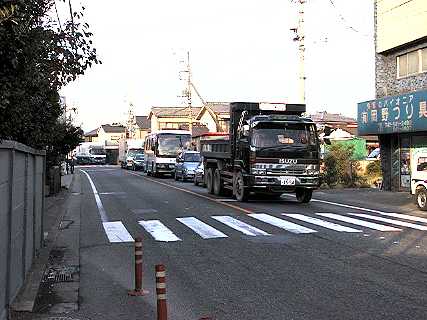
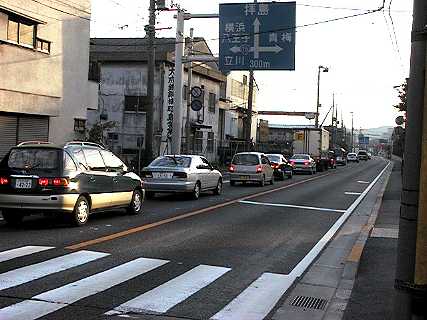
It seems that many Japanese are on the same slippery course. About 1/3 of the vehicles pictured here are in the category of personal “light trucks.”
These snapshots were taken from a corner where Highway 16 passes through our neighborhood. Three of the eight vehicles in the first snapshot are personal vans or pickup trucks. Four of the ten in the second shot are multi-passenger vans carrying one or two people. One of the three in this parking lot is an oversized SUV.
The effects on the US, and now more in Japan? Together,Iraq, Iran, Libya, and Saudi Arabia account for 21% of the world's oil. “Any time a new SUV rolls out of a U.S. car dealership, the leaders of those countries, which are often referred to as ‘state sponsors of terrorism,’ must be laughing all the way to the bank,” said The Globalist, an online newsletter.