3 in 30 - 2001.12.08 Saturday
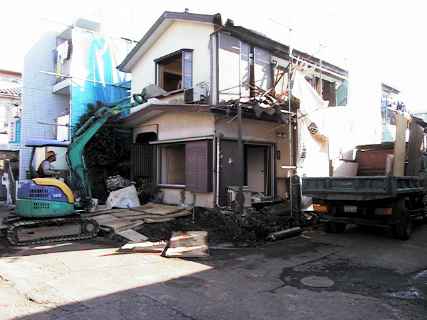
Ah, the ever changing face of our neighborhood. One more change in our immediate alleyway is taking place.
The house where we continually enjoyed the changing display of seasonal plants and flowers is coming down. About a month ago, the “Flower Lady”, whose name we now know is Kimura-san came to us to tell us they were moving. Actually, they didn’t move from the Matsubara-cho neighborhood, just closer to the Akishima station rather than the Haijima station. Little did we know what was to happen to their house.
This weekend, they started to tear it down. Speaking with Yanagawa-san, we anticipate a new apartment building to go up where this single dwelling stood.
In this first picture, you can see the backhoe preparing to remove a roof element of the house. On the ground in front of the backhoe is a stack of tatami mats. Later the backhoe will use these to get some height to remove parts of the second floor. To the right is a dump truck that will be loaded with wood scrap removed from the house.
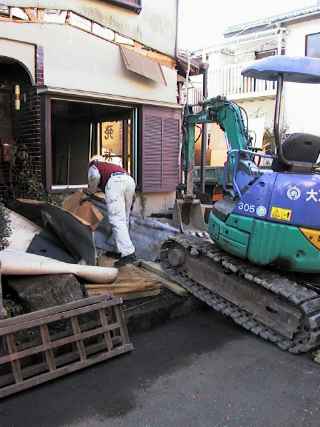
The roof part has been removed and the backhoe operator (I heard another worker call him the boss) is separating wood from metal before carting it away. There are many sizes of these backhoes. We saw one that had about a 1.2 meter tread lowered into a hole by hand to do some careful digging around some water lines. It was purple and violet rather than blue and green as this one is. It was so small that it was cute rather than being some mechanical device.
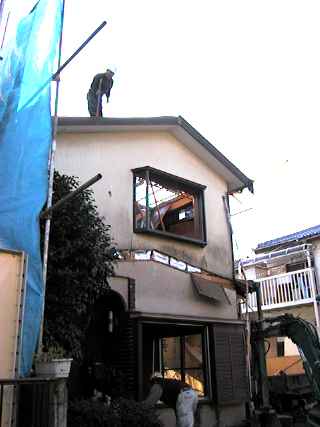
The main roof has been removed here and you can see that rather than structural rafters used in US construction, the primary structure is box-like and interior parts, walls, ceilings, etc. are simply filled in with rather light-weight lath.
The blue sheets and scaffolding visible on the left are there to protect the house next door from dust and damage during the deconstruction. Buildings are mostly deconstructed rather than destroyed. In the US, a similar project might suggest just smashing down everything, shoveling it up and carting it away to some burgeoning land fill. Some of the wood from old buildings shows up at New Years’ bonfires as a symbolic discarding of the past, while the rest may go to recycling centers to be burned to power other recycling projects.