3 in 30 - 2001.12.16 Sunday
We've been a bit busy over the past two weeks and didn't get all the pictures that we had taken posted to the web site. Forgive us our tardiness.
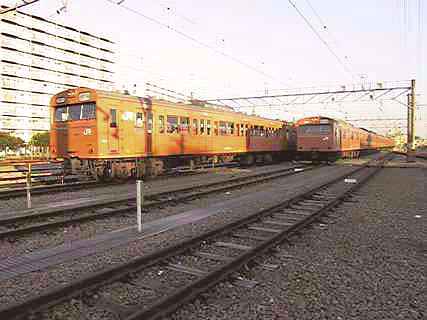
We're back at the train yards again. Late in the afternoon on a Sunday, there are a fair number of trains in the yard waiting for their turn to head out onto the main tracks. Monday morning, they will pick up passengers and head downtown to take them to work. In the afternoon, they will pick up people who have spent their day working in the city and bring them back out to the suburbs.
These commuter train cars are bright orange because they run on the Chuo and Ome lines. Other cars are different colors so that passengers can recognize them easily.
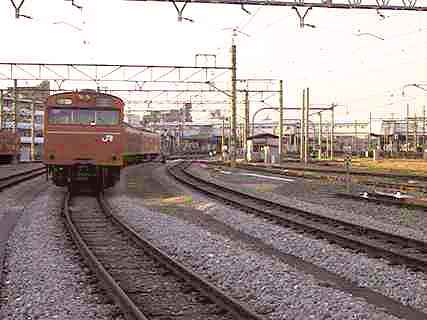
Another Chuo/Ome line train sitting in the yard waiting for the weekend to end. In the background you can see parts of the Haijima train station.
[2025 edit] It is obvious that these are run by electricity with all the overhead structure and wires. Living just aout 150 meters (500 feet) from the train tracks, we either got used to the sound of the trains or it wasn't as loud as you might think. We were thankful that we lived so near the station; in a hurry, we could get to the station in a little over four minutes.
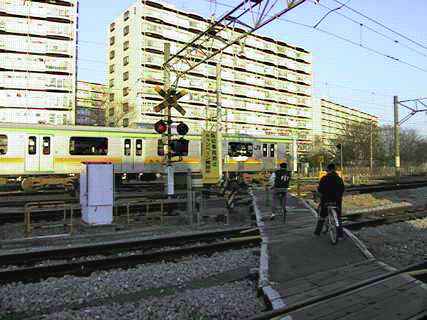
Turning to the right you can see one of the Hachiko trains passing through the yard. I ride my bicycle through this yard morning and evening and frequently have to wait for trains to pass—as these people are doing. Sometimes in the morning, I wait for half a dozen trains before I can get across.
At the Hachiko crossing, which is also the Seibu-Shijuku crossing, the train crossing bells have some added warnings. I found out while trying to record the sounds, that it doesn't play during the day, only in the mornings and evenings.
In the first ten seconds, the bells start to sound and a recorded voice asks you to be careful. Part of that is "abunai de kudasai." After another 15 seconds or so, the gate comes down and the voice says "O-jamashimas. Shibaraku de o-kudasai." Basically, she says "Pardon (the interruption). Please wait." A minute after the bells start, the gate opens and the voice says "O-machidosama deshta." The nuances are more subtle than in English, but she says "Your wait is finished." You can hear the sounds of the crossing signal by clicking on the links for the sound file. Most web browsers should be able to play these sounds. They are large files, so they may take some time to get to you.