3 in 30 - 2001.09.16 Sunday
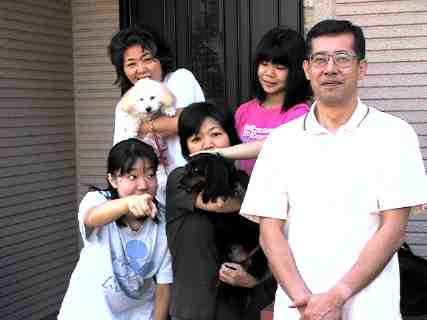
On this weekend after the terrorist attacks on citizens, visitors, and travelers in New York, Washington and Pennsylvania, it is still difficult to go out of the house and greet neighbors and acquaintances. Saturday was a holiday in Japan—Respect for the Aged Day. As is sometimes the case, Junichi Sakonaka-san was able to return home for a weekend visit from Osaka. Here he is on the right with his wife in the middle, two daughters, Ayako and Sayako. Their dog's name is Run because he likes to run so much.
To the left in the rear is Shimizu-san with her dog Ku. Both these dogs are easy to get excited, they have lots of dog spirit. Even as a passerby, it they come up to me they lavish dog kisses until they run out of water.
As I was setting out to encounter the following pictures, we spoke briefly about the terrible catastrophe in the U.S. and worried about what future actions might cause more disasters. It is difficult to express complex feelings and multilayered political and religious machinations in a language only partially understood, so our conversation was not very long, though Shimizu-san and I agreed on some points.
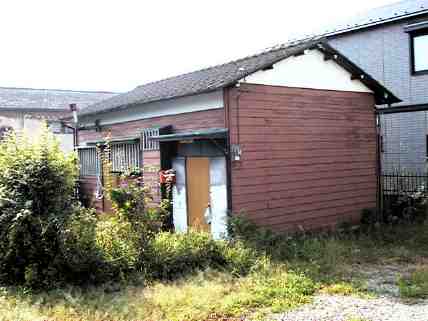
On a quiet Sunday afternoon as the heat was rising to near 29º C (84º F), riding around on my bicycle, I was struck by the contrast of these two houses that were no more than 30 meters distant from one another.
This house is an example of a style that was built en mass probably 30 or 40 years ago. There was unprecedented growth on the outskirts of Tokyo and inexpensive housing was built to accommodate people moving to the city. Throughout the area, an area that would have been not too distant from both the old Tachikawa Air Base and the current Yokota Air Base, houses similar to this can be found. This one appears to have no one living in it, but there are still cultivated plants growing around it.
The size is about 3 meters by 5 meters (15 x 25 ft.). The roof is some tile that looks like a composite cast concrete or some such. The siding is thin lap board. The front door in the near corner has probably been replaced from the original. Though I have never been in such a house, the toilet is probably to the left of the door and the kitchen to the far left corner. In the back to the right would be a "formal" room with a bedroom in the far corner. There may not have been a bath room, since public baths have a long history of popularity in Japan.
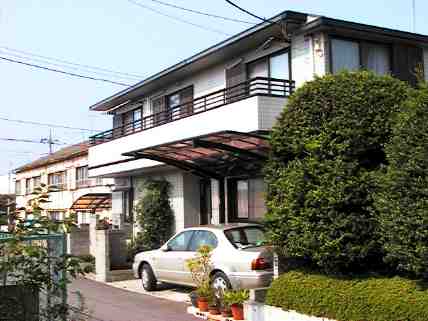
In contrast, is this new house near by. It is nearly four times the size of the house above, yet it may be on about the same size property as the other house. There are probably four bedrooms upstairs, a living room and a formal room downstairs, a spacious kitchen and dining room, along with toilets upstairs and down, certainly its own bath room (as distinct from the room with the toilet for our western readers).
You will notice the car under the carport in the foreground. This house has a second carport on the far side of the house. This is a two car household. As is the current style, not employed in the old house above, there is a balcony on the second floor, facing south, that is used for drying laundry, airing out futon (bedding).
Not quite as visible in this single snapshot are the potted plants, some near the car an others inside the wall near the entrance gate. There are some tiers just inside the gate of plants and trees that have been purposefully stunted to be Bonsai plants.
One of the things we like to do in each of the seasons is to wander around, searching out bonsai plants that reflect the changing of the seasons: blossoming plum and cherry in the early spring; small azalea bushes in the early summer; miniature maple copse with their brilliant colors in the fall. In our city, there is always the opportunity to discover some small natural beauty.