3 in 30 - 2001.09.23 Sunday
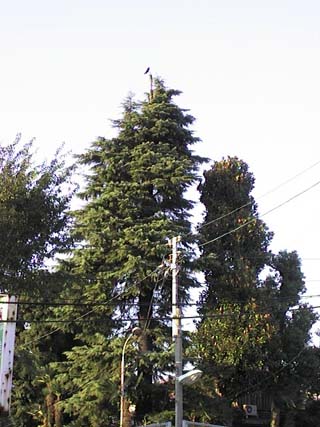
Crow in a treetop
After a week of rain brought in by a mild typhoon out in the Pacific, the weekend was clear and walking out in the neighborhood was delightful. Even Mt. Fuji was visible, capped with a new coat of snow. It is the first we have seen Fuji-san in months. Also out and about was this crow at the top of this tree.
There are two kinds of crows in Tokyo, one larger than the other. This is probably one of the smaller ones. Stories of clever crows abound, but most city dwellers consider them a nuisance. They get into garbage left out overnight and do not clean up after themselves. The cities suggest that people put out garbage in the mornings for pick up, but many people don't always follow suggestions.
We enjoy listening to them vocalize in the distance.
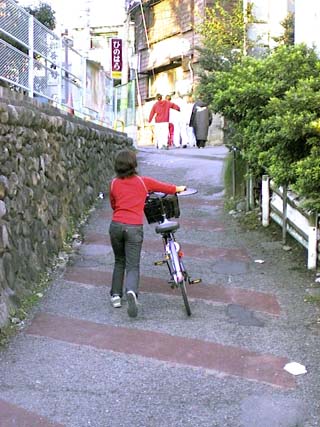
Up the bike path
Below this tree is the area where the terrain makes a drop toward the river. It is steep here and the walkway up toward the train station is steep enough that many people need to walk their bicycles up the hill.
The parking lot at the top of the wall on the left is level, so you can see the steepness of the path against the wall. The wall is one of many throughout the Kanto plain built of similar sized smooth river rocks. The rocks make an attractive wall.
The girls at the top of the hill are just leaving after having a little tête à tête in the parking lot. They apparently are wearing sports uniforms, so they must have had some kind of game this Saturday.
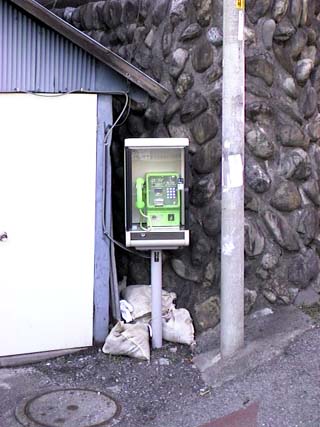
Halfway down the hill is this “green telephone.” Public telephones are omnipresent everywhere we have been. In the middle of blocks, at the corners of factory walls, on the tops of mountains, at the end of bullet train cars, and in shops of all kinds. It is difficult to imagine where there are not public phones. They often serve as useful landmarks. “Go down this street and turn left at the second green phone.”
This is one of the “green” phones. There are also pink and grey phones. The pink phones will only take small coins and are used primarily for local calls, while the green phones will take larger coins and often prepaid telephone cards. The grey phones are newer than either the pink or grey and are usually located at large train terminals and airports. These are being equipped with external telephone plugs so that people can plug in computer modems and connect via the internet to the world.
With the current saturation of cell phones, it is difficult to imagine how these immobile phones continue. On the other hand, it is easy to speculate how they came to be. Fifty years ago, when Tokyo was being rebuilt after being leveled during World War II, many people were very poor and the infrastructure for personal telecommunications was non existent. Public phones, lots of them were a national necessesity.
Phones are still not inexpensive. In order to have a telephone, you must buy a phone line. From the phone company, they are about US $700. Not a small investment. Since many people move to and from Tokyo, it is possible to buy one from someone who is leaving for less than half that price. Still, we have come to appreciate public phones.